
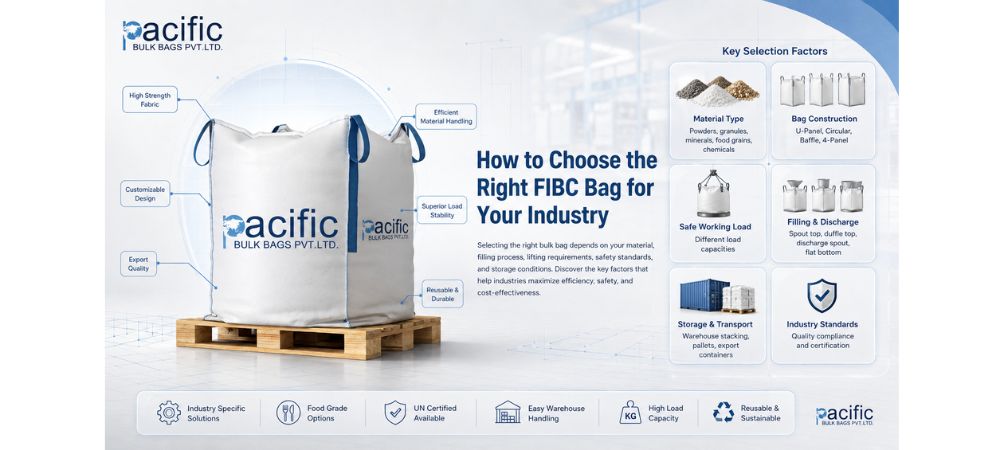
How to Choose the Right FIBC Bag for Your Industry in 2026
Choosing the right packaging solution is no longer just about storage—it is about efficiency, safety, product protection, compliance, and cost control. For industries dealing with bulk materials, Flexible Intermediate Bulk Containers (FIBCs) have become one of the most reliable and cost-effective packaging solutions. From agriculture and chemicals to food processing, construction, minerals, and pharmaceuticals, businesses across sectors rely on these versatile bulk packaging bags for transportation and storage.
However, not every FIBC bag is suitable for every application. The type of product being packed, the weight of the material, moisture sensitivity, electrostatic risk, filling and discharge requirements, and export standards all influence the right bag choice. That is why businesses must work with an experienced FIBC bags manufacturer in India that understands industry-specific packaging needs and can provide reliable, safe, and high-performance bulk packaging solutions.
In this guide, we will explain how to choose the right FIBC bag for your industry in 2026, what factors matter most, the common types of FIBC bags available, and how Pacific Bulk Bags can help you find the right fit for your operations.
What Is an FIBC Bag?
An FIBC bag (Flexible Intermediate Bulk Container), also known as a jumbo bag or bulk bag, is a large woven polypropylene bag designed for storing and transporting dry, flowable materials in bulk quantities. These bags are widely used because they are lightweight, strong, reusable in many cases, and highly customizable.
Industries use FIBC bags for:
- Fertilizers
- Seeds and grains
- Cement and sand
- Minerals and powders
- Chemicals and polymers
- Food ingredients and spices
- Waste and recyclables
- Construction materials
A reliable jumbo bags manufacturer in India offers FIBC solutions in multiple sizes, designs, fabric strengths, and filling/discharge options to suit different industries.
Why Choosing the Right FIBC Bag Matters in 2026
In 2026, packaging decisions are influenced by much more than price. Businesses are under pressure to improve operational efficiency, reduce product loss, meet safety standards, support export requirements, and manage warehouse space better. Using the wrong FIBC bag can lead to:
- Product contamination
- Leakage or tearing during transit
- Difficulty in handling and stacking
- Moisture damage
- Electrostatic hazards
- Higher logistics costs
- Regulatory non-compliance
- Wastage and customer complaints
That is why selecting the right product from a trusted bulk bags supplier India is a strategic decision rather than a routine purchase.
Key Factors to Consider Before Choosing an FIBC Bag
1) Understand Your Industry and Product Type
The first step is to evaluate what material you are packing. Different industries require different bag features.
Agriculture
Agriculture businesses often need FIBC bags for:
- Grains
- Seeds
- Animal feed
- Fertilizers
- Sugar
- Rice and pulses
For agricultural products, breathable fabric, UV protection, easy filling, and safe storage are important.
Food Processing
Food manufacturers and exporters need food-grade industrial bulk bags that protect the product from contamination, dust, and moisture. Liners, hygienic production standards, and compliance with food safety requirements become critical here.
Chemical Industry
Chemical products may require:
- Moisture-resistant liners
- Anti-static or conductive bags
- Stronger stitching and high safety factor
- UN-certified bags for hazardous materials
Construction and Minerals
For cement, sand, minerals, fly ash, or industrial powders, heavy-duty load-bearing capacity, easy discharge, and durability are the key priorities.
A knowledgeable FIBC bags manufacturer in India should first understand your industry and product handling requirements before recommending a bag design.
2) Determine the Required Load Capacity
FIBC bags are available in different load capacities, depending on the material weight and handling conditions. Common capacities include:
- 500 kg
- 1000 kg
- 1200 kg
- 1500 kg
- 2000 kg or more, depending on design and application
When selecting the right bag, ask:
- What is the weight of the product per bag?
- Will the bags be stacked?
- Will they be moved by forklift or crane?
- Will they be used for export or domestic transport?
- Is it a single-use or multi-use application?
Choosing the wrong capacity can increase the risk of damage, operational delays, and safety issues. A professional jumbo bags manufacturer in India will help calculate the right Safe Working Load (SWL) and safety factor for your application.
3) Choose the Right FIBC Bag Type
One of the most important steps is selecting the correct bag construction. There are several common types of FIBC bags, and each serves a different purpose.
a) U-Panel Bags
These are made from three body panels—two side panels and one panel forming the bottom. They are cost-effective and widely used across industries.
Best for: fertilizers, grains, powders, and general industrial use.
b) 4-Panel Bags
These bags have four separate side panels stitched together with a bottom panel. They offer better shape retention and printing surface.
Best for: applications where appearance, stacking, and shape consistency matter.
c) Circular / Tubular Bags
These are made from a circular woven tube, which reduces side seams and improves strength.
Best for: heavy-duty industrial applications.
d) Baffle Bags
Baffle bags have internal panels stitched into the corners, helping the bag maintain a square shape when filled.
Best for: maximizing storage space, improving stackability, and reducing shipping costs.
e) Ventilated Bags
These are designed with breathable fabric for products that require airflow.
Best for: onions, potatoes, and agricultural produce.
If your product has unique handling or storage needs, a manufacturer offering custom FIBC bags can design a solution that matches your exact requirements.
4) Check the Filling and Discharge Design
The way a bag is filled and emptied can directly impact workflow efficiency. Different filling and discharge options are available based on material flow and process requirements.
Top / Filling Options
- Open top
- Duffle top
- Spout top
- Flap top
Bottom / Discharge Options
- Flat bottom
- Discharge spout
- Duffle bottom
- Conical discharge
How to choose:
- Powders and free-flowing materials often work well with discharge spouts.
- Manual loading operations may prefer open top or duffle top designs.
- Dust-sensitive products may need spout top closure for better sealing.
A reliable bulk bags supplier India should recommend a filling/discharge design that aligns with your machinery and handling process.
5) Evaluate Fabric Strength and Safety Factor
Not all FIBC bags are made for the same usage pattern. Some are designed for single-trip use, while others are built for multiple uses.
Common Safety Factors:
- 5:1 – typically used for single-trip bags
- 6:1 – suitable for multi-trip use under proper conditions
The right choice depends on:
- whether the bag will be reused
- transport conditions
- product weight
- stacking requirements
- customer or export specifications
Working with an experienced FIBC bags manufacturer in India ensures you get the right safety factor and fabric quality for your application.
6) Consider Static Protection Requirements: Type A, B, C, or D
If your business handles fine powders, chemicals, or flammable materials, electrostatic discharge becomes an important factor.
Type A
Standard bags with no special electrostatic protection.
Type B
Prevent high-energy brush discharges but are not grounded.
Type C
Conductive bags that must be grounded during filling and discharge.
Type D
Anti-static bags designed to safely dissipate static without grounding under specific conditions.
These bag types are especially relevant in:
- chemical manufacturing
- powders and solvents
- hazardous material handling
- industrial processing units
For such applications, consult a trusted jumbo bags manufacturer in India to ensure you select the correct electrostatic-safe bag type.
7) Do You Need a Liner?
Many industries require an inner liner to protect the product from moisture, oxygen, contamination, or leakage. Liners can significantly improve product safety and shelf life.
FIBC liners are useful for:
- fine powders
- food products
- chemicals
- pharma ingredients
- moisture-sensitive materials
Common liner types include:
- form-fit liners
- loose liners
- tabbed liners
- aluminium liners for specialized applications
If product purity matters, ask your supplier about custom FIBC bags with integrated liner options.
8) Check Whether You Need Food-Grade or UN-Certified Bags
Food-Grade FIBC Bags
Food-grade bags are designed for products like:
- flour
- sugar
- spices
- grains
- pulses
- starch
- food ingredients
These bags are manufactured under strict hygiene standards to reduce contamination risk.
UN-Certified FIBC Bags
UN bags are required for transporting certain hazardous or dangerous goods. They are tested and certified to meet specific international safety requirements.
If your business exports or handles sensitive materials, your FIBC bags manufacturer in India should be able to provide food-grade, pharma-grade, or UN-certified solutions based on need.
9) Think About Storage, Stacking, and Transportation Efficiency
Bulk packaging is not just about filling a bag—it is also about how well it performs in warehouses, shipping containers, and transport vehicles.
When evaluating industrial bulk bags, consider:
- Will the bags be stacked?
- How much warehouse space is available?
- Do you need square-shaped bags for better palletization?
- Are the bags exported in containers?
- Will moisture or UV exposure be a concern?
For businesses trying to optimize logistics and storage, baffle bags or specially designed custom FIBC bags may be a better choice than standard bags.
10) Look for Customization Options
Many industries have unique packaging needs. That is why standardized bags may not always be the best fit. A trusted FIBC bags manufacturer in India should offer a wide range of customization options, including:
- Bag dimensions
- Fabric GSM
- Top and bottom construction
- Printing and branding
- Liner options
- UV stabilization
- Loop configuration
- Color options
- Dust-proof or sift-proof stitching
- Baffle design
- Food-grade or anti-static features
If your product handling process is specialized, custom FIBC bags can improve both operational efficiency and brand presentation.
11) Choose a Manufacturer with Industry Expertise and Quality Standards
Even the best bag design will fail if the manufacturer lacks quality control, testing standards, or industry experience. Choosing the right supplier is just as important as choosing the right bag.
When evaluating a FIBC bags manufacturer in India, look for:
- experience across multiple industries
- consistent quality standards
- strong stitching and fabric quality
- customization capabilities
- export-ready manufacturing
- food-grade and specialized bag options
- timely production and delivery
- technical guidance on bag selection
- testing and compliance support
A trusted bulk bags supplier India should act as a packaging partner, not just a vendor.
Industry-Wise Guide to Choosing the Right FIBC Bag
Below is a quick reference guide to help businesses choose the most suitable FIBC bag based on industry use.
| Industry | Recommended FIBC Features |
| Agriculture | Ventilated or standard bags, UV protection, easy discharge, high-volume storage |
| Food Processing | Food-grade fabric, liners, contamination control, hygienic manufacturing |
| Chemicals | Liners, Type B/C/D protection, high safety factor, possible UN certification |
| Construction | Heavy-duty fabric, large capacity, easy discharge, rugged handling strength |
| Minerals & Powders | Dust-proof design, discharge spout, strong seams, moisture protection |
| Pharmaceutical / Specialty Materials | High-purity liner, contamination control, specialized barrier properties |
Common Mistakes to Avoid When Choosing FIBC Bags
Many businesses focus only on price and overlook technical suitability. Here are some common mistakes to avoid:
- Choosing the wrong bag size – Oversized or undersized bags can create handling issues and waste storage space.
- Ignoring material compatibility – A bag suitable for grain may not be suitable for fine powders or chemicals.
- Overlooking moisture protection – Without a liner or proper fabric choice, moisture-sensitive products may get damaged.
- Not checking electrostatic risk – For hazardous environments, using the wrong FIBC type can create serious safety issues.
- Using standard bags for specialized applications – Food, chemicals, and export products often need customized solutions.
- Buying only on price – Low-cost bags can result in product loss, rejections, and higher long-term costs.
Why Pacific Bulk Bags Is the Right Partner for Your FIBC Packaging Needs
At Pacific Bulk Bags, we understand that every industry has unique bulk packaging requirements. As a trusted FIBC bags manufacturer in India, we offer durable, high-performance, and application-specific FIBC solutions designed to support safe storage, efficient transport, and better product protection.
Our product capabilities are built around the needs of modern industries in 2026. Whether you need standard industrial bulk bags, food-grade packaging, agriculture bags, chemical-safe designs, or fully custom FIBC bags, our team works closely with clients to recommend the most suitable solution based on their product, handling process, and market requirements.
With Pacific Bulk Bags, you get:
- High-quality FIBC and jumbo bag solutions
- Industry-specific packaging guidance
- Custom bag designs for unique applications
- Reliable manufacturing and quality assurance
- Solutions for agriculture, food, chemicals, construction, and more
- Support from an experienced jumbo bags manufacturer in India
If your business is looking for a dependable bulk bags supplier India that combines quality, customization, and technical expertise, Pacific Bulk Bags is ready to help.
Final Thoughts
Choosing the right FIBC bag in 2026 is about much more than selecting a container. It is about finding the best packaging solution for your product, industry, logistics, compliance needs, and long-term operational efficiency. From load capacity and fabric strength to electrostatic safety, liners, food-grade standards, and discharge design, every detail matters.
By partnering with an experienced FIBC bags manufacturer in India, businesses can avoid costly packaging mistakes and ensure safer, smarter, and more efficient bulk material handling. Whether you operate in agriculture, chemicals, food processing, construction, or exports, the right FIBC bag can improve product protection, storage efficiency, and transportation performance.
At Pacific Bulk Bags, we help businesses choose packaging that works for their industry—not just for today, but for the future of bulk handling in 2026 and beyond.
FAQs – How to Choose the Right FIBC Bag
1. What is the best FIBC bag for agricultural products?
For agricultural materials like grains, seeds, and fertilizers, the right FIBC bag depends on the product type, weight, and ventilation requirements. Standard or ventilated bags with UV protection are commonly used.
2. Are food-grade FIBC bags different from standard bags?
Yes. Food-grade FIBC bags are produced under stricter hygiene and quality standards to reduce contamination risks for food products like flour, sugar, spices, and grains.
3. When should I choose a baffle bag instead of a standard jumbo bag?
Baffle bags are ideal when you need better shape retention, improved stacking, and more efficient use of storage or container space.
4. Why are liners used in FIBC bags?
Liners help protect moisture-sensitive, fine, or contamination-prone products. They are often used in food, chemicals, powders, and pharmaceutical materials.
5. How do I choose between Type A, B, C, and D FIBC bags?
The choice depends on the electrostatic risk of your product and operating environment. Hazardous materials and fine powders often require specialized static-protection bags.