
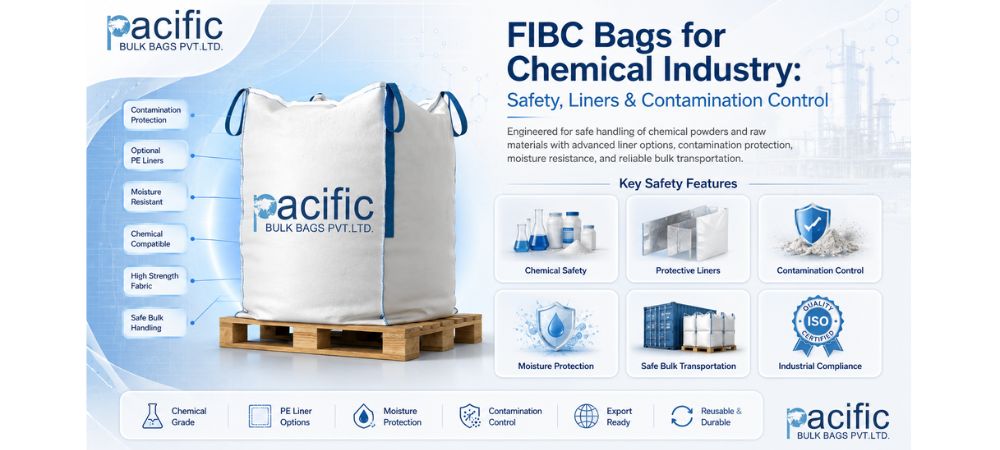
FIBC Bags for Chemical Industry: Safety, Liners & Contamination Control
The chemical industry depends on packaging that does much more than simply hold material. Chemical products often include fine powders, granules, hazardous compounds, moisture-sensitive substances, and materials that can react to contamination, static discharge, or poor handling conditions. In such cases, packaging becomes a critical part of product safety, quality assurance, and operational efficiency. That is why FIBC bags for chemicals in India have become one of the most trusted bulk packaging solutions for chemical manufacturers, exporters, and industrial processors.
FIBCs—also known as jumbo bags or bulk bags—offer a practical way to store, transport, and handle bulk chemicals across manufacturing plants, warehouses, and export supply chains. However, the chemical industry has unique packaging demands. A standard bag may not always be suitable when the product requires moisture protection, contamination control, electrostatic safety, or specialized discharge systems. The right chemical jumbo bags must be selected based on the product’s physical properties, hazard level, filling and discharge process, storage conditions, and transportation requirements.
In this blog, we will explore why FIBC bags for chemicals in India are widely used in the chemical sector, what safety factors matter most, how liner bags for chemicals improve protection, and what contamination control measures businesses should look for when choosing a supplier. If your company is searching for dependable chemical packaging solutions, this guide will help you understand how to select the right packaging partner in 2026.
Why the Chemical Industry Needs Specialized FIBC Bags
The chemical sector handles a wide variety of products, including industrial powders, petrochemical materials, pigments, resins, additives, agrochemicals, specialty compounds, and hazardous substances. These materials often need packaging that can protect them from:
- Moisture and humidity
- External contamination
- Leakage during filling or transport
- Electrostatic discharge
- Dust release and material loss
- Product degradation due to poor handling
- Cross-contamination between batches
- Damage during stacking, warehousing, and export transit
For these reasons, businesses increasingly prefer FIBC bags for chemicals in India because they are strong, flexible, cost-effective, and highly customizable. When designed correctly, they help maintain product integrity while also making bulk handling easier across the supply chain.
A trusted FIBC bags manufacturer in India can provide packaging designed specifically for the chemical industry, taking into account not only product weight and handling needs but also static protection, liners, filling spouts, discharge systems, and regulatory requirements.
What Are FIBC Bags and Why Are They Used for Chemicals?
An FIBC (Flexible Intermediate Bulk Container) is a large woven polypropylene bag designed to store and transport dry, flowable materials in bulk quantities. They are widely used across industries such as food, agriculture, construction, minerals, and chemicals.
In the chemical sector, FIBCs are used for products such as:
- Polymer granules
- Pigments and dyes
- Resins and masterbatches
- Industrial salts
- Fertilizer chemicals
- Detergent raw materials
- Specialty powders
- Additives and compounds
- Petrochemical intermediates
Compared with smaller sacks or rigid containers, chemical jumbo bags offer multiple advantages:
- easy forklift handling
- higher storage efficiency
- lower packaging and logistics cost
- reduced manual handling
- customizable designs for product safety
- suitability for export and industrial use
However, not every bag is suitable for every chemical application. The right chemical packaging solutions must address safety, liners, contamination control, and compatibility with the material being packed.
Key Safety Considerations for FIBC Bags in the Chemical Industry
1. Product Compatibility
The first step in choosing FIBC bags for chemicals in India is understanding the nature of the chemical product. Different products have different risks:
- Fine powders may leak if the stitching is not sift-proof
- Moisture-sensitive chemicals may degrade without liner protection
- Flammable powders may require antistatic protection
- Hazardous materials may need UN-certified bags
- Heavy-density chemicals may require reinforced load capacity
A bag that works for polymer granules may not be suitable for reactive powders or hazardous chemicals. That is why product compatibility should always come before cost or standard bag selection.
2. Load Capacity and Safety Factor
Chemical products are often packed in large quantities, so the bag must be designed for the correct Safe Working Load (SWL). Depending on the product, chemical jumbo bags may be designed for 500 kg, 1000 kg, 1200 kg, 1500 kg, or more.
In addition to load capacity, the safety factor is equally important:
- 5:1 safety factor – usually for single-trip use
- 6:1 safety factor – suitable for multi-trip use under proper conditions
The bag must be selected based on:
- material weight
- stacking requirements
- filling and discharge method
- transportation distance
- whether the bag will be reused
For chemical packaging, poor load planning can lead to bag failure, leakage, and handling risks, which is why working with an experienced manufacturer is essential.
3. Static Electricity and Antistatic Protection
One of the biggest concerns in chemical packaging is electrostatic discharge. Many powders and chemicals can generate static during filling, discharging, and movement. In environments where flammable vapors, combustible dust, or sensitive materials are present, static discharge can create serious hazards.
This is where antistatic bulk bags become important.
Types of FIBC Bags for Static Safety
Chemical applications often use the following bag types:
Type A
Standard FIBC bags with no electrostatic protection. Suitable only for non-flammable products in low-risk environments.
Type B
These reduce the risk of propagating brush discharges but do not provide full grounding protection.
Type C
Conductive bags made with interconnected conductive threads. These bags must be grounded during use.
Type D
Static-dissipative bags designed to prevent dangerous sparks without the need for grounding under defined conditions.
For many chemical and powder applications, antistatic bulk bags are a better choice than standard bags because they help reduce ignition risk and improve handling safety.
The Role of Liners in Chemical FIBC Bags
Why Liners Matter
For many chemical products, the outer woven bag alone is not enough. Chemicals may require an internal liner for protection against moisture, contamination, oxygen, leakage, or chemical interaction with the outer packaging. That is why liner bags for chemicals are one of the most important components in bulk chemical packaging.
Liners help in:
- preventing moisture ingress
- reducing contamination risk
- containing fine powders
- minimizing leakage
- improving product purity
- protecting hygroscopic or sensitive chemicals
- creating a better barrier between product and outer fabric
A properly selected liner can significantly improve the performance of FIBC bags for chemicals in India, especially when the material is fine, sensitive, or contamination-prone.
Common Types of Liner Bags for Chemicals
1. Loose Liners
These are inserted inside the FIBC and remain separate from the outer bag structure. They are commonly used for general moisture protection and basic product containment.
2. Form-Fit Liners
These liners are shaped to match the FIBC design and provide a closer fit inside the bag. They help improve discharge efficiency and reduce liner movement during filling and transport.
3. Tabbed Liners
Tabbed liners are attached to the corners or loops of the bag to hold them in position. They are useful when liner stability and consistent filling are important.
4. Barrier Liners
For chemicals that need advanced protection from moisture, oxygen, or contamination, barrier liners may be used as part of high-performance chemical packaging solutions.
Choosing the right liner bags for chemicals depends on the product’s particle size, moisture sensitivity, flow behavior, and contamination control requirements.
Contamination Control in Chemical Packaging
In the chemical industry, contamination can lead to product rejection, batch failure, safety issues, customer complaints, and financial loss. That is why contamination control should be a major consideration when selecting FIBC bags for chemicals in India.
Sources of Contamination in Bulk Chemical Packaging
Contamination may occur due to:
- dust or fibers entering the bag
- poor storage conditions
- moisture exposure
- reused or low-quality liners
- unclean manufacturing conditions
- improper stitching or fabric shedding
- cross-contamination during packing and handling
To prevent these risks, chemical businesses should choose chemical jumbo bags designed with product safety in mind.
Features That Support Better Contamination Control
1. Sift-Proof Stitching
Fine powders can leak through stitched seams if the bag is not properly designed. Sift-proof stitching helps reduce powder loss and contamination.
2. Inner Liners
As mentioned above, liner bags for chemicals create an extra protective layer and help maintain product purity.
3. Dust-Proof Construction
Dust-proof top closures, sealed spouts, and proper liner integration reduce the chance of external contamination and product escape.
4. Hygienic Manufacturing Practices
A reliable manufacturer should follow clean production and handling processes to reduce the risk of contamination during bag manufacturing.
5. Proper Bag Storage and Transport
Even the best bag can fail if stored in wet, dirty, or unsafe conditions. Chemical FIBCs should be stored in clean, dry environments and handled carefully during transport.
Choosing the Right FIBC Design for Chemical Applications
Not all chemicals need the same bag design. Depending on the material and handling process, the following design features may be important:
Top Filling Options
- Open top
- Duffle top
- Spout top
- Flap top
Bottom Discharge Options
- Flat bottom
- Discharge spout
- Duffle bottom
- Conical discharge
Loop Options
- Cross corner loops
- Side seam loops
- Stevedore straps
Other Customization Features
- UV stabilization
- printed branding
- anti-static fabric
- coated or uncoated fabric
- custom dimensions
- baffle construction for shape retention
- liner integration
- sift-proof seams
For example:
- fine powders may need spout filling and discharge with liner support
- moisture-sensitive chemicals may need form-fit liners and coated fabric
- export products may need better stackability and print identification
- hazardous materials may require UN-certified chemical packaging solutions
This is why many buyers prefer custom FIBC bags rather than one-size-fits-all packaging.
When Are UN-Certified Chemical FIBC Bags Required?
Some chemicals are classified as hazardous materials and may require UN-certified packaging for transport. These bags are tested for strength, drop resistance, stacking, and other safety parameters according to international standards.
UN-certified FIBC bags for chemicals in India may be required for:
- hazardous powders
- toxic materials
- flammable compounds
- dangerous industrial chemicals
- regulated export cargo
If your product falls into a regulated category, your packaging supplier should guide you on the appropriate certification and bag design.
Benefits of Using the Right FIBC Bags for Chemicals in India
When selected properly, FIBC bags offer several benefits for chemical manufacturers and exporters:
- Better Product Protection – The right combination of bag fabric, liner, and closure system protects chemicals from contamination, moisture, and leakage.
- Improved Workplace Safety – Using the correct antistatic bulk bags and appropriate load design reduces risks during filling, storage, and discharge.
- Efficient Bulk Handling – FIBCs are easy to lift, stack, store, and transport, reducing manual handling and improving operational flow.
- Lower Packaging and Logistics Cost – Compared to smaller sacks or rigid containers, bulk bags often reduce material cost, labor, and shipping inefficiencies.
- Customization for Industry Needs – From liners to discharge spouts to anti-static properties, chemical jumbo bags can be tailored to your exact application.
- Better Export Readiness – Well-designed FIBCs support container optimization, labeling, and compliance for international shipments.
How to Choose the Right Supplier for Chemical FIBC Bags
Choosing the right packaging partner is just as important as choosing the bag itself. When evaluating a supplier for FIBC bags for chemicals in India, look for the following:
- experience in chemical industry packaging
- ability to recommend the right liner and bag type
- expertise in antistatic bulk bags and safety requirements
- customization capabilities for dimensions, spouts, and liners
- strong quality control and testing
- support for UN-certified or export-oriented packaging where required
- reliable production and delivery timelines
- understanding of contamination control standards
A dependable supplier should not simply sell a bag—they should understand your product, your plant process, and your safety expectations.
Final Thoughts
The chemical industry cannot rely on generic bulk packaging when product safety, contamination control, and handling risks are at stake. The right FIBC bags for chemicals in India should be selected based on the chemical’s properties, storage and transport conditions, moisture sensitivity, electrostatic risk, and discharge requirements.
From chemical jumbo bags designed for heavy-duty handling to liner bags for chemicals that improve barrier protection and antistatic bulk bags that reduce static-related hazards, every design element plays a role in maintaining product quality and operational safety. Businesses that invest in the right chemical packaging solutions not only protect their materials better but also improve efficiency across warehousing, transport, and export operations.
If you are looking for dependable, industry-focused bulk packaging, Pacific Bulk Bags is ready to help with FIBC solutions built for the chemical sector.
FAQs – FIBC Bags for Chemical Industry
1. Why are FIBC bags used in the chemical industry?
FIBC bags are used because they provide a strong, cost-effective, and customizable way to store and transport bulk chemicals such as powders, granules, additives, and industrial compounds.
2. What are liner bags for chemicals used for?
Liner bags for chemicals help protect the product from moisture, contamination, leakage, and external exposure. They are especially useful for fine powders and moisture-sensitive chemicals.
3. Are antistatic bulk bags necessary for chemical products?
For chemicals or powders that can generate static electricity, antistatic bulk bags may be necessary to reduce ignition risk and improve handling safety.
4. What is the difference between a standard FIBC bag and a chemical jumbo bag?
A chemical jumbo bag is often designed with features such as liner compatibility, anti-static properties, sift-proof stitching, and specialized discharge systems to meet chemical packaging requirements.
5. How do I choose the right FIBC bags for chemicals in India?
You should consider product type, moisture sensitivity, hazard level, load capacity, electrostatic risk, liner requirement, discharge design, and contamination control needs before selecting the right bag.