
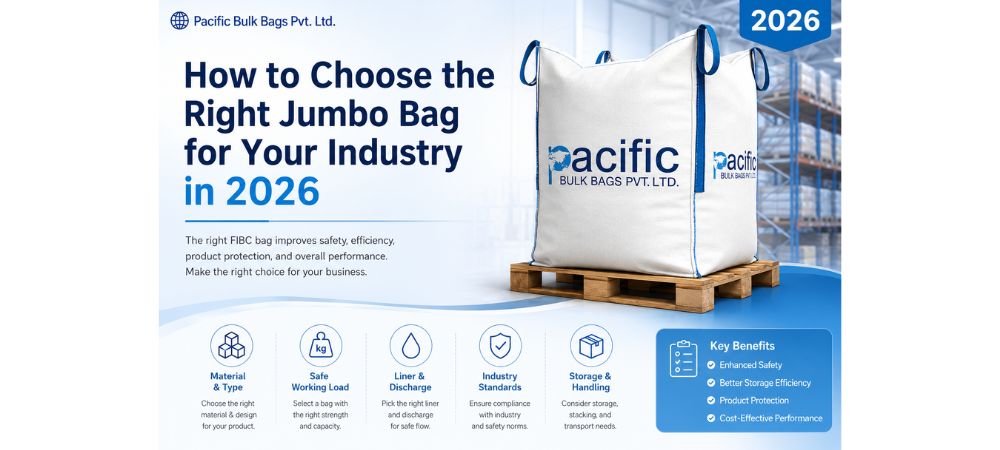
How to Choose the Right Jumbo Bag for Your Industry in 2026
Bulk packaging plays a major role in the efficiency, safety, and cost-effectiveness of industrial operations. Whether you are handling chemicals, food ingredients, fertilizers, minerals, seeds, construction materials, or polymers, the packaging you choose directly affects product protection, storage, transport, handling, and even customer satisfaction. That is why selecting the right jumbo bag is not just a packaging decision—it is a business decision.
In 2026, industries are demanding more from bulk packaging than ever before. Companies want stronger bags, better contamination control, improved warehouse efficiency, export-ready performance, and industry-specific customization. This is where working with a reliable jumbo bags manufacturer in India becomes important. The right manufacturer does more than supply packaging—they help businesses choose bags that match the product, process, compliance needs, and supply chain realities.
Jumbo bags, also known as FIBC bags (Flexible Intermediate Bulk Containers), are one of the most widely used industrial bulk bags for storing and transporting dry, flowable materials in bulk quantities. But not all jumbo bags are the same. A bag suitable for food grains may not be right for chemicals, and a bag used for minerals may not work well for export-grade agricultural products. From fabric design and load capacity to liners, loops, discharge systems, and anti-static features, every element matters.
This blog serves as a practical FIBC bag selection guide for businesses that want to make the right packaging choice in 2026. We will cover the key factors you should evaluate before buying jumbo bags, the most common bag types used across industries, and how Pacific Bulk Bags can help you find the right bulk packaging solution for your specific needs.
What Are Jumbo Bags?
Jumbo bags are large woven polypropylene bulk containers designed to store and transport dry, free-flowing materials such as powders, granules, flakes, and agricultural products. They are commonly used in industries like chemicals, agriculture, food processing, construction, minerals, plastics, and exports.
These bags are popular because they are:
- strong and lightweight
- easy to fill, lift, stack, and transport
- cost-effective for bulk storage and shipping
- customizable for different product types
- suitable for domestic and export logistics
Because of their versatility, jumbo bags have become one of the most preferred industrial bulk bags across a wide range of sectors. However, the benefits depend on choosing the correct bag type and construction for your material and handling process.
Why Choosing the Right Jumbo Bag Matters
Selecting the wrong jumbo bag can lead to serious problems such as:
- product leakage or contamination
- bag failure during handling
- inefficient stacking and storage
- excess packaging costs
- difficulty in filling or discharge
- moisture damage during transport
- safety issues in chemical or hazardous environments
- reduced product shelf life for food and agricultural materials
That is why a structured FIBC bag selection guide is essential. Instead of choosing a bag only by price, businesses should consider the product characteristics, weight, application, transportation needs, storage conditions, and industry standards before placing an order with a bulk bags supplier India.
Step-by-Step Guide to Choosing the Right Jumbo Bag for Your Industry in 2026
1. Understand Your Industry and Product Type
The first step in choosing the right jumbo bag is understanding exactly what material you need to pack. Different industries have very different packaging requirements.
Examples by industry:
- Food industry: grains, flour, sugar, pulses, starch, spices
- Agriculture: seeds, fertilizers, animal feed, crop nutrients
- Chemical industry: powders, granules, additives, specialty compounds
- Construction industry: cement, sand, fly ash, minerals
- Plastic & polymer industry: resins, masterbatches, polymer granules
A chemical powder may require anti-static protection and liners, while food ingredients may require food-grade, contamination-controlled packaging. A fertilizer bag may need moisture resistance and UV stability, while a mineral bag may need extra strength for heavy loads.
This is why a reliable jumbo bags manufacturer in India will first ask what product you are packing before recommending a bag type.
2. Determine the Load Capacity You Need
Jumbo bags are available in a wide range of sizes and load capacities. Common capacities include:
- 500 kg
- 750 kg
- 1000 kg
- 1250 kg
- 1500 kg
- 2000 kg or more for specific applications
When choosing among industrial bulk bags, you should consider:
- weight of material per bag
- density of the material
- stacking height
- warehouse handling conditions
- transportation distance
- whether the bag is for single use or repeated use
Using a bag with incorrect capacity can create safety risks, increase product loss, and reduce operational efficiency. The bag should be designed not just for the product weight, but also for the way it will be handled across the supply chain.
3. Check the Safe Working Load (SWL) and Safety Factor
One of the most important parts of any FIBC bag selection guide is understanding Safe Working Load (SWL) and Safety Factor (SF).
Safe Working Load (SWL)
This refers to the maximum weight the bag is designed to carry safely.
Safety Factor (SF)
This indicates how much stress the bag can withstand compared to its rated working load.
Common safety factor categories:
- 5:1 Safety Factor – generally used for single-trip jumbo bags
- 6:1 Safety Factor – commonly used for multi-trip or reusable jumbo bags
If your bags will be reused, stored for longer periods, or transported across long export routes, you may need a stronger design. A trusted bulk bags supplier India should help you select the correct safety factor based on your operational use.
4. Choose the Right Jumbo Bag Construction Type
Not all jumbo bags are built the same. The structure of the bag affects filling efficiency, storage, shape retention, and discharge performance. The most common types include:
a) U-Panel Jumbo Bags
These are made from three main fabric panels and are widely used for general bulk packaging.
Best for:
- fertilizers
- food grains
- industrial raw materials
- powders and granules
b) 4-Panel Jumbo Bags
These are made with four side panels and one bottom panel, offering better shape and stability.
Best for:
- products requiring improved bag shape
- stackable warehouse storage
- export shipments
c) Circular Jumbo Bags
Made from tubular woven fabric, circular bags are often cost-effective and suitable for many industrial applications.
Best for:
- standard industrial materials
- cost-sensitive packaging requirements
d) Baffle Jumbo Bags
Also called Q bags, these have internal baffles that help the bag retain a square shape when filled.
Best for:
- efficient container loading
- better warehouse stacking
- export shipments where space optimization matters
For companies trying to reduce freight cost and improve storage efficiency, baffle custom jumbo bags can be an excellent option.
5. Select the Right Top Filling and Bottom Discharge Design
Another critical step in choosing the right jumbo bag is deciding how the bag will be filled and emptied.
Common top options
- Open top – simple filling for general products
- Duffle top – easy to fill and close
- Spout top – controlled filling for powders and granular materials
- Flap top – added protection from dust and contamination
Common bottom options
- Flat bottom – basic discharge handling
- Discharge spout – easy and controlled unloading
- Conical bottom – smoother discharge for certain materials
- Duffle bottom – suitable for manual emptying
The correct filling and discharge system depends on:
- the flow characteristics of your product
- whether the material is powder, granule, or flaky
- whether your facility uses automated filling systems
- how the customer or end-user will unload the material
A proper FIBC bag selection guide always considers how the bag will work in the real production environment, not just during storage.
6. Decide Whether You Need Liners
Not every jumbo bag needs a liner, but for many products, liners are essential.
Liners are commonly used for:
- moisture-sensitive products
- fine powders that may leak through stitching
- chemicals that require contamination control
- food ingredients requiring better hygiene
- products that need an additional barrier layer
If your material is hygroscopic, contamination-sensitive, or very fine in particle size, then a liner can significantly improve bag performance. Many custom jumbo bags are designed with integrated liners for specific food and chemical applications.
7. Consider Anti-Static or Conductive Protection for Chemicals
For the chemical industry, static electricity can be a serious hazard. Powders and chemicals may generate static during filling and discharge, especially in dry environments.
If you are packing flammable powders, hazardous materials, or chemicals used in static-sensitive environments, you may need:
- Type B jumbo bags
- Type C conductive jumbo bags
- Type D anti-static jumbo bags
These are specialized industrial bulk bags designed to reduce the risk of dangerous electrostatic discharge. If your product falls into the chemical or hazardous category, your jumbo bags manufacturer in India should advise you on the correct anti-static bag type.
8. Evaluate Moisture, UV, and Storage Conditions
Packaging performance depends heavily on the conditions in which the bags will be stored and transported.
Ask yourself:
- Will the bags be stored outdoors?
- Is the product sensitive to moisture?
- Will the bags be exposed to sunlight for long periods?
- Are the bags being shipped during monsoon or humid weather?
- Will the bags sit in warehouses for extended periods?
If the answer to any of these is yes, then you may need:
- UV-stabilized fabric
- laminated outer fabric
- internal liners
- better top closure systems
- moisture-protection design
These factors are especially important for fertilizers, agro products, food ingredients, and export shipments.
9. Think About Industry Compliance and Product Safety
Different industries have different compliance expectations. For example:
Food Industry
Food-grade jumbo bags may require:
- hygienic manufacturing conditions
- contamination control
- safe raw materials
- product-specific liner support
Chemical Industry
Chemical packaging may require:
- anti-static protection
- UN-certified bags for hazardous goods
- better sealing and contamination control
Agriculture & Exports
Agro products and export shipments may require:
- moisture resistance
- UV stability
- reliable stacking strength
- custom printing and product identification
Choosing a bulk bags supplier India with experience in your industry helps ensure that the bag design aligns with these operational and compliance expectations.
10. Consider Customization Instead of Buying Standard Bags
Many businesses still buy standard jumbo bags for all materials, but in 2026, customization is often the smarter approach. Custom jumbo bags allow you to align the bag with your product, handling system, and supply chain requirements.
Customization options may include:
- bag size and dimensions
- fabric GSM
- load capacity
- filling and discharge spouts
- top and bottom closure styles
- baffle design
- liners
- printing and labeling
- lifting loop style
- anti-static or food-grade construction
A fertilizer company may need a very different bag from a food exporter or polymer manufacturer. Customization helps improve performance, reduce waste, and support better logistics planning.
11. Assess Warehouse Handling and Transportation Needs
Before finalizing the bag, consider how it will move through your warehouse and supply chain.
Important questions:
- Will the bag be moved by forklift or crane?
- How high will it be stacked?
- Will it be transported in trucks, containers, or rail?
- Is export container optimization important?
- Does the customer need easy unloading at the destination?
The answers to these questions affect bag dimensions, loop style, baffle design, and load capacity. For example, a company focused on exports may benefit more from square-shaped custom jumbo bags that improve container utilization.
12. Choose a Reliable Jumbo Bags Manufacturer in India
Even the best bag design will not perform well if the manufacturer lacks quality control, industry understanding, or customization capability. Choosing the right jumbo bags manufacturer in India is one of the most important decisions in the entire buying process.
What to look for in a manufacturer
- experience across multiple industries
- ability to recommend the right bag type
- customization capabilities
- strong quality testing and production standards
- support for food-grade, anti-static, or liner-based bags
- export packaging experience
- reliable delivery timelines
- transparent communication and technical guidance
The right supplier should act like a packaging partner—not just a bag seller.
How Different Industries Choose Jumbo Bags
To make this FIBC bag selection guide more practical, here is a simple overview of how different industries typically choose their jumbo bags.
| Industry | Common Product | Key Bag Features |
| Food Processing | Flour, sugar, starch, grains | Food-grade bag, liner, contamination control, moisture protection |
| Agriculture | Seeds, fertilizers, feed | UV resistance, moisture protection, strong lifting loops |
| Chemical Industry | Powders, additives, compounds | Anti-static options, liners, sift-proof seams, safe discharge |
| Construction | Sand, cement, fly ash, minerals | Heavy-duty fabric, high load capacity, durable handling performance |
| Plastics & Polymers | Resin, masterbatch, granules | Clean discharge, liner options, stackability, custom sizing |
Why Pacific Bulk Bags Is the Right Partner for Jumbo Bags in 2026
At Pacific Bulk Bags, we understand that no two industries have the same packaging needs. As a trusted jumbo bags manufacturer in India, we work closely with businesses to deliver packaging solutions that are strong, efficient, and tailored to the product and industry they serve.
We manufacture and supply industrial bulk bags designed for sectors such as:
- agriculture
- chemicals
- food processing
- construction
- fertilizers
- minerals
- polymers and industrial raw materials
Whether you need standard FIBC bags or fully custom jumbo bags, Pacific Bulk Bags focuses on quality, strength, performance, and application-specific design. From bag type selection and load capacity planning to liners, anti-static options, and export-friendly configurations, we help businesses choose packaging that fits their operations—not just their budget.
Why businesses choose Pacific Bulk Bags
- trusted jumbo bags manufacturer in India
- customized solutions for different industries
- support for food, chemical, agro, and industrial applications
- reliable supply and consistent manufacturing quality
- expert guidance based on product type and usage conditions
- strong focus on safety, durability, and bulk handling efficiency
If your business is looking for a dependable bulk bags supplier India, Pacific Bulk Bags can help you select the right jumbo bag for 2026 and beyond.
Final Thoughts
Choosing the right jumbo bag is not about picking a standard size and placing an order. It requires a deeper understanding of your product, industry, storage conditions, transport requirements, safety needs, and operational process. The right bag can reduce product loss, improve warehouse efficiency, support safe handling, and lower overall packaging costs. The wrong bag can do the opposite.
That is why businesses should follow a structured FIBC bag selection guide before buying. From product compatibility and load capacity to liners, top and bottom designs, anti-static protection, and customization, every factor plays a role in the success of bulk packaging.
If you are looking for a reliable jumbo bags manufacturer in India that understands these challenges and can deliver high-quality industrial bulk bags for your application, Pacific Bulk Bags is ready to help with durable, efficient, and industry-specific bulk packaging solutions.
FAQs – Choosing the Right Jumbo Bag
1. How do I choose the right jumbo bag for my industry?
You should consider the product type, bag capacity, filling and discharge process, storage conditions, moisture sensitivity, safety requirements, and whether you need customization such as liners or anti-static protection.
2. What are industrial bulk bags used for?
Industrial bulk bags are used for storing and transporting bulk materials such as grains, fertilizers, chemicals, minerals, polymers, powders, and construction materials.
3. When should I use custom jumbo bags?
You should choose custom jumbo bags when your product has specific needs related to moisture protection, contamination control, discharge design, branding, export logistics, or handling equipment.
4. Do all jumbo bags need liners?
No, but liners are highly useful for moisture-sensitive products, fine powders, food ingredients, and chemicals that require better contamination control.
5. Why is it important to choose the right jumbo bags manufacturer in India?
A reliable manufacturer ensures proper bag design, strong material quality, industry-specific guidance, customization support, and dependable supply for your packaging requirements.